

Cafe renovation for a growing franchise should consider what happens when one visible component becomes worn. A damaged cupboard door, kick panel or counter front does not automatically mean the whole unit needs replacement. Whether a smaller repair is practical depends on details agreed before fabrication: how parts connect, how they are identified and whether the supplier can reproduce them.
For Selangor operators planning several outlets, use the next branch to review these details deliberately. The aim is a workable replacement process for selected high-contact components. It is not a promise that every joinery item can be dismantled, nor a reason to weaken a detail that needs strength, moisture resistance or secure fixing.
Start with the parts most likely to need attention
Walk a comparable operating outlet with the person responsible for maintenance. Identify where trolleys, shoes, bags, cleaning tools and repeated handling meet the joinery. Record the component and the everyday activity beside it. A cabinet side in a quiet corner may need a different approach from a front panel beside a busy collection point.
Separate appearance problems from functional defects. A scratched decorative face, a loose hinge and a swollen substrate need different decisions. Ask the designer and fabricator which components can reasonably become individual replacement items. Concentrate on a short, useful list rather than requiring every surface to be removable.
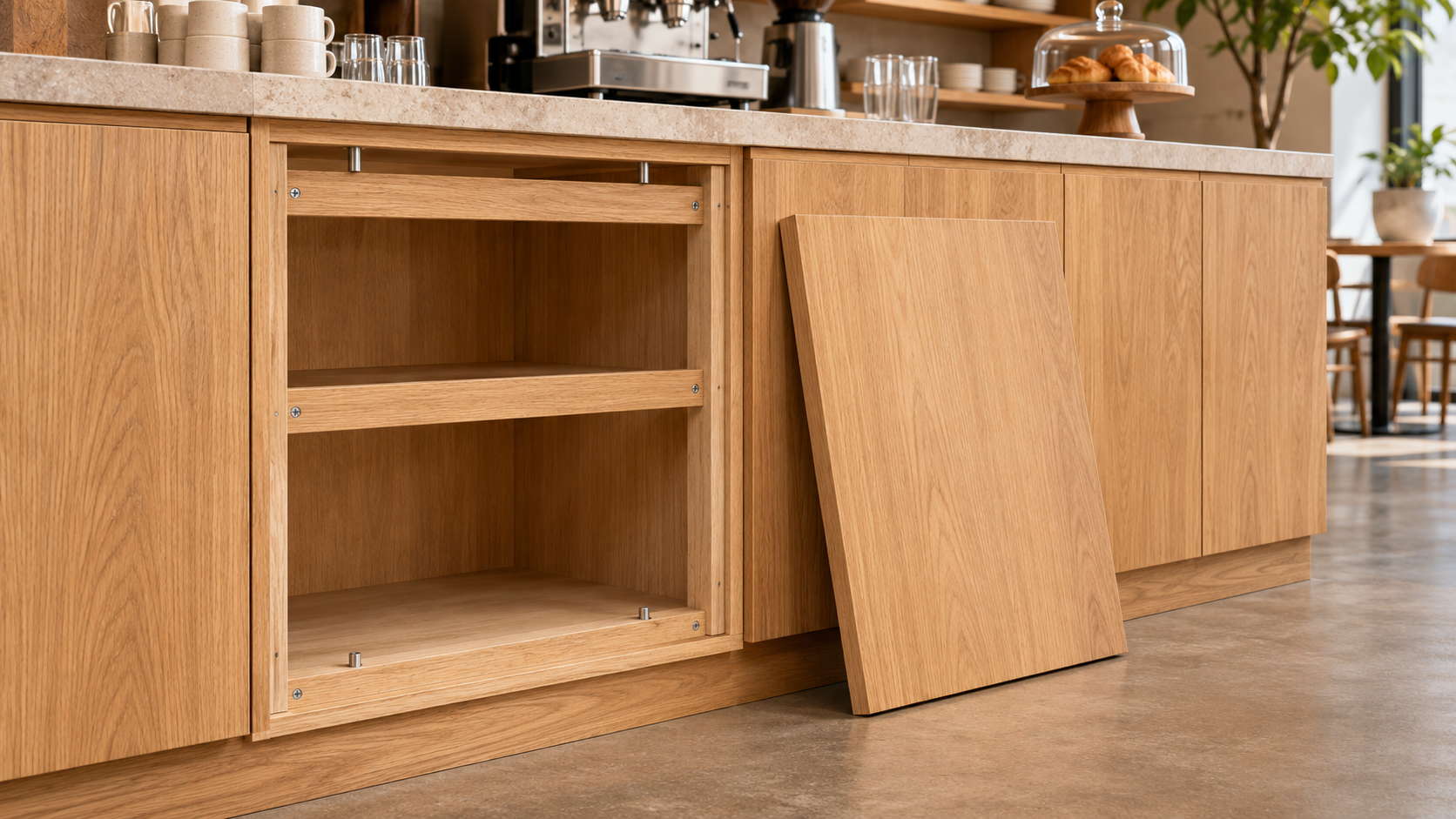
Ask how each component comes out
Request a detail showing the proposed fixing, the access direction and the adjacent parts that must be moved. A concealed screw may look tidy but be unreachable after equipment is installed. A removable face is less useful if it can only leave the unit after the entire counter is dismantled.
The Ellen MacArthur Foundation’s design exercise on disassembly asks how components are connected and whether individual replacement parts are available. Apply that questioning approach to your joinery review. It is a design prompt, not evidence that a particular cafe detail is economical or technically suitable.
Have the responsible fabricator explain the removal sequence and any limits. Do not ask branch staff to dismantle structural supports, electrical enclosures or unfamiliar service interfaces. Agree which tasks belong to routine upkeep and which require a qualified contractor or specialist supplier.
| Component | Review before fabrication | Evidence to keep |
|---|---|---|
| Counter front | Can the panel be released without disturbing equipment or services? | Approved fixing detail and access sequence |
| Cupboard door | Are dimensions, hinge positions and finish orientation recorded? | Door reference and hardware specification |
| Kick panel | Will removal preserve the required support and finish junction? | Detail showing fixing and reinstatement |
| Handle or fitting | Can an exact compatible replacement be obtained? | Supplier reference and confirmed alternatives |
Standardise interfaces where the design allows it
A common appearance does not establish that parts are interchangeable. Two branches may have different opening sizes, counter depths or hinge positions. Mark the parts that genuinely share dimensions and connections, and keep location-specific components separate. Ask the fabricator to confirm compatibility instead of assuming it from a photograph.
Where appropriate, define a small family of repeatable parts. Give each one a reference linked to the approved drawing, material, edge treatment, fixing and finish direction. A replacement request should identify the actual part. Descriptions such as “the oak panel at the front” leave too much room for confusion.
Review finish matching as well as dimensions
A new panel can fit correctly yet look different beside an older surface. Ask about batch variation, grain direction and the supplier’s approach to matching later replacements. Keep approved samples and a clear record of what was supplied, while recognising that a retained sample is a reference rather than a guarantee of a perfect future match.
Discuss the visible boundary of a repair. Would replacing one door be acceptable, or would a paired set need review for appearance? Agree that decision with the brand team before an urgent repair arises. The cafe materials and maintenance guide can support the wider discussion about cleaning and surface selection.
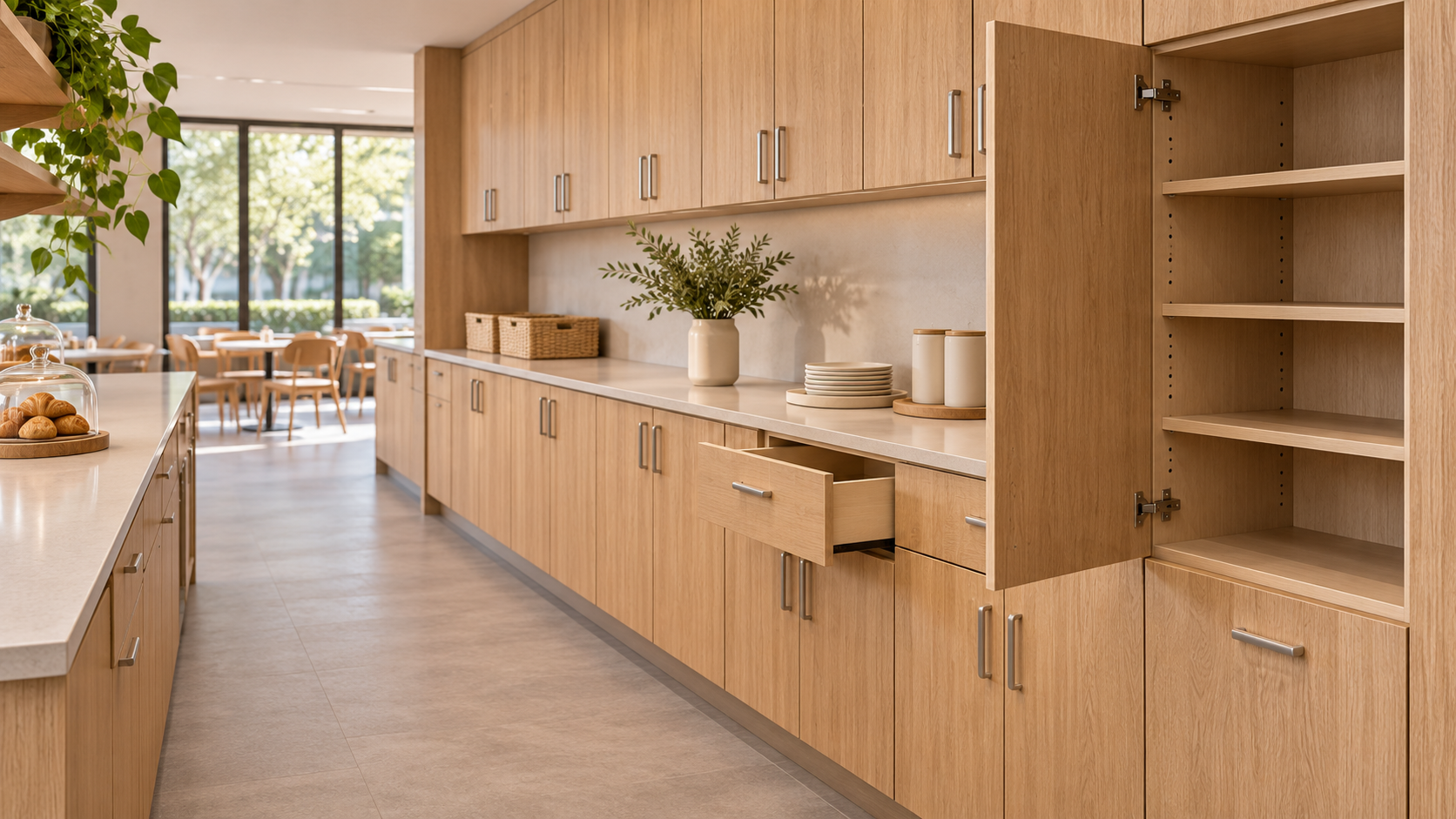
Make spare-part decisions with the supplier
Ask what remains available as a stock item and what must be fabricated to order. Clarify storage conditions, packaging and identification if the business chooses to keep spares. Holding a spare that has no clear branch or part reference can create another maintenance problem. Avoid buying large quantities before the design and dimensions are settled.
Test one representative replacement during the pilot review where practical. Have the fabricator demonstrate removal, handling and reinstatement, then check alignment and operation afterwards. Record any access problem before repeating the detail. This practical check concerns the repair method; it does not replace the normal quality checks for the completed unit.
Release a clear repair brief to every branch
- Identify the component by branch, location and part reference.
- Photograph the problem and describe whether function is affected.
- Confirm the replacement specification and authorised installer.
- Check the affected area after reinstatement and record completion.
Keep the repair brief short enough for the branch team to use. Review recurring faults with the designer before another rollout so the team can decide whether the detail itself needs improvement. A repeatable process is useful only when the component can be identified, ordered and restored without guesswork.
Frequently asked questions
Should all cafe joinery be removable?
No. Select appropriate components with the designer and fabricator. Required strength, fixing, moisture control and service interfaces still need to be addressed.
Does standard joinery guarantee interchangeable parts?
No. Verify dimensions, fixing positions and finish references. Premises-specific changes can make visually similar components different.
How many spare panels should we keep?
Decide with the supplier after confirming likely replacement needs, availability and suitable storage. There is no universal quantity for every cafe.
Discuss your cafe project with APIO
Use the APIO project planner to share your premises, menu, project stage and priorities. Tell us which decisions remain open so we can discuss the design support your cafe needs.